Every day a vehicle sits in your shop or on a back lot, it costs you money. Most independent dealers know this in a general sense — but when you put the actual numbers on it, the impact of a slow vehicle reconditioning workflow becomes hard to ignore.
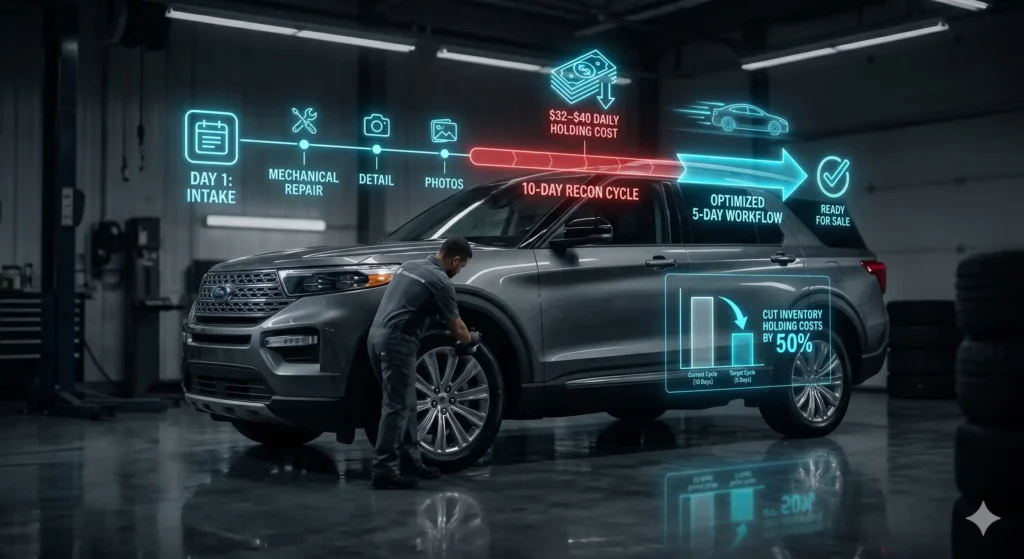
The national average holding cost for a used vehicle is $32–$40 per day, per unit. If you’re reconditioning 50 vehicles a month with a 10-day average recon cycle — which is common — that’s roughly $192,000 in holding costs per year before you factor in price erosion, lost VDP views, and the last-minute discounts that pile up on aging inventory. Tighten your vehicle reconditioning workflow from 10 days to 5, and that number drops in half.
This isn’t a theoretical exercise. It’s a process problem with a process solution.
Why Recon Takes Longer Than It Should
The national average recon cycle runs 10–12 days. The target for high-performing dealers is 3–5 days. That gap — five to nine days — doesn’t usually come from mechanics working slowly or detail bays being backed up. It comes from breakdowns between steps.
Status confusion is the most common culprit. When a service manager doesn’t know a car is waiting for parts sign-off, or when a detail bay doesn’t know a unit is cleared for final inspection, vehicles sit in limbo. Nobody is failing at their job. The workflow is just invisible.
The Hidden Cost of Handoff Delays
Think about what happens between the moment a trade comes in and the moment it hits your lot. There’s the initial inspection, the repair order, parts ordering, mechanical work, detail, photos, and pricing. Every one of those handoffs is an opportunity for a vehicle to sit for a day or two while someone figures out what happens next.
For a 50-unit-per-month operation, shaving three days off the average recon cycle adds up to 150 vehicle-days per month recovered. At $36/day average holding cost, that’s $5,400/month — or about $65,000 per year — that stops leaking out of your gross.
See Pricing Strategies and Software Hacks 🔗
What a Strong Vehicle Reconditioning Workflow Looks Like
A well-structured recon process has a few non-negotiable characteristics.
Every VIN has a defined status at all times. Not “it’s in service” — but specifically where in the process it is, who owns the next step, and when that step is expected to close. This single change — moving from informal status-checking to a tracked workflow — is where most dealers find the biggest time savings.
Approvals are fast and visible. Parts approvals and repair authorizations are among the top reasons vehicles stall mid-recon. When your service manager has to chase down a decision by text or email, hours disappear. A workflow system that routes approvals with clear visibility and timestamps takes that variable off the table.
Vendors are on the clock. Outside vendors — window tint, paint correction, PDR, aftermarket accessories — are some of the hardest parts of recon to control. But they’re still part of your cycle time. Building expected turn times into your process and tracking vendor performance over time helps you set expectations and identify who’s consistently slowing you down.
The 3-to-5 Day Benchmark: Is It Realistic?
Yes — but it requires the right structure. According to Rapid Recon and Digital Dealer, the dealers hitting 3–5 day recon cycles have a few things in common: they track every step, they have clear ownership for each handoff, and they review their pipeline daily.
“Top performers on LotWalk average 22 annual turns,” according to LotPop’s guide to used car inventory management. That means vehicles are moving, on average, every 16–17 days from acquisition to sale. That’s only possible when recon isn’t burning up 10 of those days.
See From Trade-In to Turnaround 🔗
Pricing and Merchandising Can’t Wait for Recon to Finish
One of the most expensive habits in independent used car retail is waiting until a vehicle is fully through recon before taking photos and building the VDP listing. By the time the car hits your website, it may have already spent 8–10 days in your store with zero market exposure.
Top-performing dealers start the merchandising process before the vehicle is frontline-ready. Photos happen as soon as the unit is cleaned up enough to shoot. The listing goes live with a build-out date noted if needed. That way, the vehicle starts accumulating VDP views, market exposure, and potentially leads before it ever hits the lot.
Every day you shave off between acquisition and market exposure is a day you didn’t lose.
How to Diagnose Your Current Recon Process
Before you can fix your vehicle reconditioning workflow, you need to know where time is actually going. Pull a sample of your last 30 units and track the date of each major milestone:
– Acquisition date
– Inspection completed
– Repair order opened
– Parts ordered (if applicable)
– Mechanical work completed
– Detail completed
– Photos taken and listing live
– Frontline date
Map that out for 30 vehicles and you’ll immediately see where the time is going. Most dealers are surprised. The bottleneck is almost never where they assumed it was.
According to AFC (Auto Finance Corporation), the most common time leaks are status confusion, stalled approvals, vendor delays, parts bottlenecks, and late merchandising. Now you can look at your own data and find out which of those is your biggest problem.
Tracking Recon Performance Week Over Week
You can’t improve what you don’t measure. Average Days in Recon (ADR) is the metric that matters most. Track it weekly, broken down by acquisition type if possible — auctions may have different recon patterns than trades, for example.
Set a target. Review variance when you miss it. Treat recon performance the same way you’d treat sales performance — with weekly accountability and clear goals.
Cox Automotive and other industry observers have noted that used car margin compression is putting more pressure on operational efficiency. Front-end gross is harder to protect when market pricing is competitive. That makes holding cost reduction — something you can fully control — one of the highest-leverage levers available to an independent dealer right now.
How Carketa Supports a Faster Recon Cycle
Carketa’s reconditioning workflow tools give independent dealers real-time visibility into where every vehicle stands — from acquisition through frontline. You can track step-by-step progress by VIN, set approval workflows, monitor vendor turn times, and identify where your process is losing days.
Combined with Carketa’s competitive pricing data, trade appraisal tools, and inventory sourcing integrations (including KBB, JD Power, Manheim, Dealertrack, and DealerSocket), you get a complete picture of your inventory health — not just the recon piece.
If your recon cycle is running longer than 7 days and you’re not sure why, that’s the first thing worth fixing. See how Carketa can help you cut time-to-frontline at carketa.com.
Frequently Asked Questions
What is a vehicle reconditioning workflow?
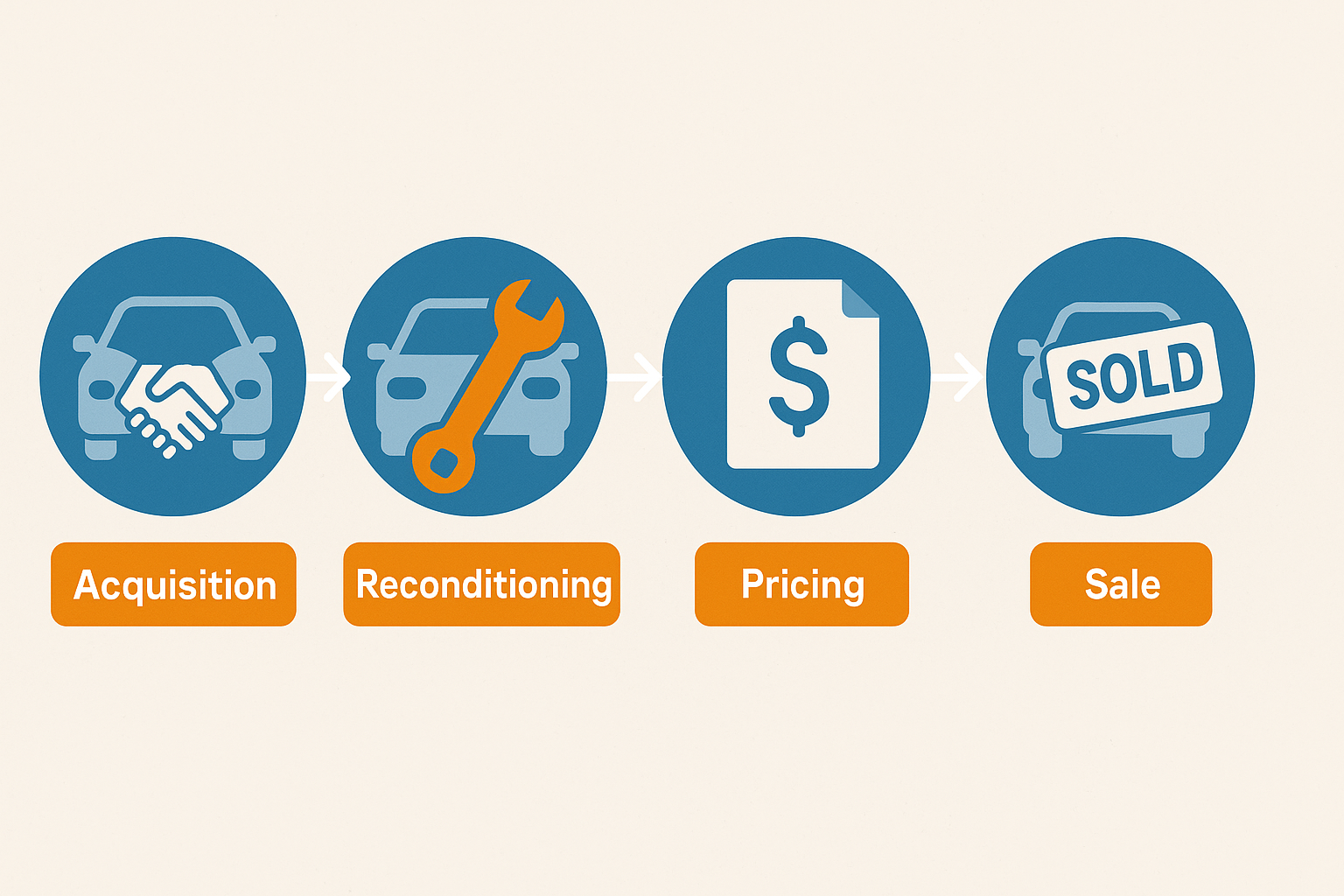
A vehicle reconditioning workflow is the step-by-step process a dealership uses to prepare a used vehicle for sale after acquisition — including inspection, repair authorization, mechanical work, detailing, photography, and pricing. A structured workflow assigns clear ownership and timelines to each step, reducing the time vehicles spend in limbo between stages.
What is the average vehicle reconditioning time for independent dealers?
The national average recon cycle is 10–12 days, but high-performing dealers consistently hit 3–5 days. The gap between average and top-performing operations typically comes from handoff delays, status confusion, and stalled approvals — not from the mechanical work itself. Tracking Average Days in Recon (ADR) is the first step to understanding where your time goes.
How much do holding costs affect used car profitability?
Holding costs for used vehicles average $32–$40 per vehicle per day, according to NCM Associates. For a dealer reconditioning 50 vehicles per month at a 10-day average recon cycle, that translates to approximately $192,000 in annual holding costs. Cutting the cycle to 5 days saves roughly $96,000 per year without changing a single purchase price or markdown decision.